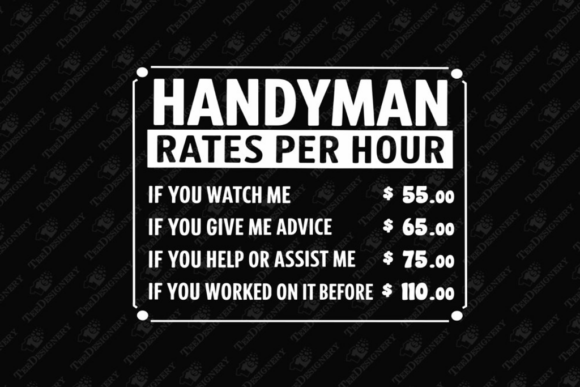
Handyman Rates Per Hour Funny Repairman
As a designer who spends more time than I care to admit staring at stitch density charts and testing thread tension, I approach every new digital asset with a healthy dose of skepticism. The market is flooded with clip art that looks great on a screen but falls apart under the needle. That is why when I encountered the Handyman Rates Per Hour Funny Repairman design, I didn’t just look at it; I stress-tested it mentally against real-world production scenarios. This isn’t just another graphic for a T-Shirt Designs category; it is a specific type of Graphics asset that speaks directly to a niche audience: tradespeople, DIY enthusiasts, and the people who love them.
The immediate mood this design creates is one of lighthearted professionalism. It taps into the universal humor of hourly rates without crossing into offensive territory. For an embroidery project, this balance is crucial. You want the customer to laugh, but you also want them to feel proud wearing it on the job site or in their home workshop. The visual personality here is bold and straightforward, which is exactly what you need for machine embroidery. Subtle gradients or delicate lines often get lost in the fabric weave, but a design with clear intent and readable typography translates much better when digitized.
Real-World Application and Project Fit
Let’s talk about where this actually lives. In my studio, I recently prepped a batch of custom embroidered tote bags for a local hardware store giveaway. The client wanted something that celebrated the staff without being too corporate. The Handyman Rates Per Hour Funny Repairman file fit perfectly. When I placed it on the canvas tote, the contrast between the heavy-duty fabric and the crisp embroidery stitches gave it a rugged, authentic feel. It wasn’t trying to be high fashion; it was trying to be useful and funny, which is the sweet spot for craft business items.
However, the versatility of this design extends far beyond tote bags. Imagine this as sweatshirt embroidery for a cold winter day on a construction site. The humor provides a moment of levity during a long shift. Or consider it as baby embroidery for a newborn onesie—because let’s face it, if the dad is a handyman, the kid is likely already part of the crew. The design works beautifully as a personalized gift, whether it’s stitched onto a cap, a patch for a tool belt, or even a kitchen towel for the home cook who happens to fix everything else.
For Etsy sellers and small shop owners, this is a goldmine. It fits seamlessly into holiday embroidery collections. Think Christmas gifts for brothers, husbands, or fathers. The "handyman" angle allows you to target multiple buyer personas simultaneously. A woman buying a gift for her husband will appreciate the humor, while a man buying it for himself sees it as a badge of honor. This dual appeal increases conversion rates because the product feels both intimate and universally relatable.
Technical Performance and Stitch Clarity
When evaluating an embroidery file, the devil is always in the details. With the Handyman Rates Per Hour Funny Repairman design, we have to consider how different stitch types interact. If the digitizer used a satin stitch for the main text, it needs to be wide enough to cover the fabric but not so dense that it puckers thin materials. Fill stitch areas should be balanced to prevent the fabric from becoming stiff, especially if this ends up on a wearable item like a t-shirt or apron.
I often advise checking designs in black and white mockups first. Why? Because color can distract from layout issues. In monochrome, you can see if the negative space is working. Does the text crowd the edges? Are the corners of the letters too sharp for a standard needle to execute cleanly? For this particular design, the layout appears robust. It doesn’t rely on tiny, intricate details that might break down after a few washes. This is critical for commercial embroidery projects where durability matters. A finished product that starts unraveling after two cycles destroys brand trust faster than anything else.
Thread colors play a massive role here. If you are stitching this on dark fabric, you’ll need a strong underlay and possibly a top stabilizer to ensure the threads sit flat. Conversely, on light fabrics, the contrast must be sharp enough to maintain readability. I recommend testing various thread colors before committing to a large run. Sometimes, a standard black thread doesn’t pop as well as a charcoal grey or a deep navy, depending on the base fabric hue.
Where to Exercise Caution
No design is perfect for every surface. There are specific scenarios where you should hold back on using the Handyman Rates Per Hour Funny Repairman file. Avoid placing this on highly textured fabrics like heavy burlap or bouclé unless you are prepared for significant distortion. The uneven surface will interfere with the needle’s path, leading to skipped stitches or misaligned elements.
Similarly, be cautious with stretchy fabrics. Unless you are using a specialized knit stabilizer and adjusting your tension settings, the design may warp as the fabric stretches and contracts. Curved surfaces, such as baseball caps or curved hat panels, also require careful placement. While the design might look fine on a flat mockup, wrapping it around a curve can distort the text, making the humor less effective if the words become hard to read.
Small hoop sizes are another limitation. If you try to shrink this design down too much to fit a tiny patch or a miniature accessory, you risk losing the integrity of the lettering. Embroidery has physical limits; pixels don’t, but needles do. Keep the design within its optimal hoop size range to ensure clarity. Also, inspect any small decorative accents closely. If they are mere pixels in the source file, they may disappear entirely when stitched, leaving a cluttered or incomplete look.
Strategic Advice for Makers and Sellers
For those of you running a digital product shop or selling handmade goods, presentation is half the battle. Use printable mockups that show the design in context. Don’t just display the raw embroidery file; show it on a rugged work shirt, a cozy fleece, or a sturdy apron. This helps the buyer visualize the finished product and understand the value proposition. A well-styled mockup can elevate a simple graphic into a desirable commodity.
Before you start mass-producing, always test the design on scrap fabric. Check the stitch density and confirm the hoop size requirements. Review the file to ensure it includes all necessary components. If the product description mentions SVG and PNG formats, remember that these are vector and raster graphics, not necessarily the direct machine-readable files (like PES or DST) needed for your embroidery machine. You may need to convert or trace these assets depending on your workflow. Always check licensing terms before selling finished items. Commercial use rights vary wildly, and assuming you have them can lead to legal headaches.
Ultimately, the Handyman Rates Per Hour Funny Repairman design succeeds because it understands its audience. It’s not overly complicated, it’s visually striking, and it carries a message that resonates with a large segment of the population. By treating it with the respect due a professional embroidery project—testing thoroughly, choosing the right fabrics, and presenting it effectively—you can turn this simple graphic into a standout piece for your portfolio or shop. Whether you are a hobbyist making a gift or an Etsy seller looking for your next bestseller, this design offers a solid foundation for creating memorable, functional, and fun handmade products.